WELCOME TO INTRODUCTORY BIOMEDICAL IMAGING
Imaging is everywhere. We use our eyes to see and cameras to take
pictures. Scientists use microscopes and telescopes to peer into cells
and out to space. Doctors use ultrasound, X-rays, radioisotopes, and
MRI to look inside our bodies. If you find these applications intriguing
and are curious about imaging, you have come to the right place!
This website explores cutting-edge biomedical imaging techniques
and the physics underlying them. The website takes a four-faceted approach.
The first facet, “Teaching Materials,” is traditional and features a
complete set of lecture notes, PowerPoint slides, in-class activities,
subject matter reviews, and practice examinations from a one-semester
"Biomedical Imaging” course taught at Lewis & Clark College in Portland,
Oregon. The second facet, “Case Studies,” is observational and features
applications of biomedical imaging to real-life medical and veterinary
situations. The third facet, “Simulations,” is experiential and features
four suites of standalone medical imaging simulations, with supporting
materials, covering ultrasound, radiography, radionuclide imaging, and
MRI. Finally, the fourth facet, a “Biomedical Imaging Blog,” is
conversational and features regular posts on imaging and related topics,
big and small.
This website also builds upon and complements the textbook treatment
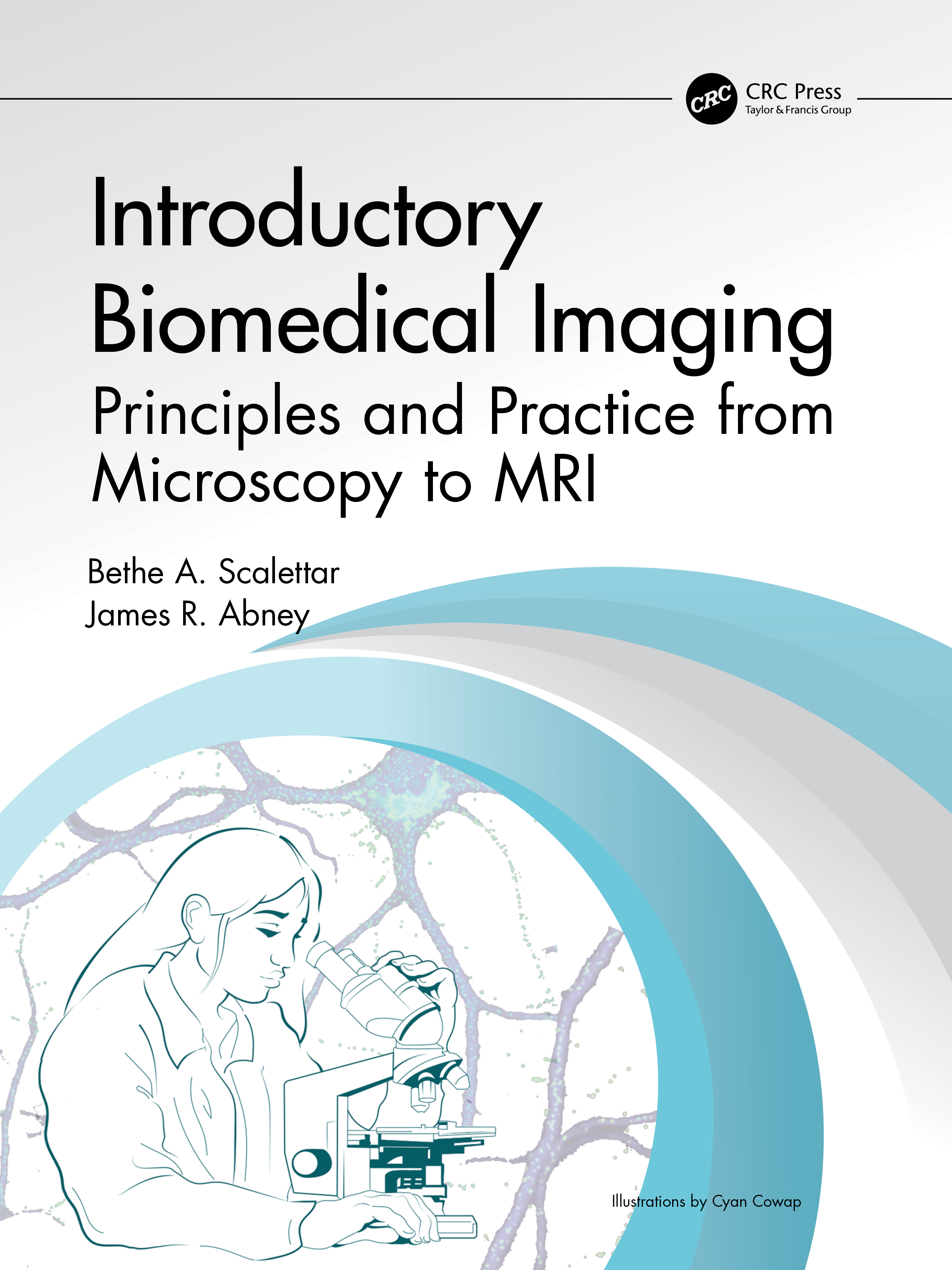
of imaging presented in “Introductory Biomedical Imaging: Principles and
Practice from Microscopy to MRI.” This undergraduate textbook uses
elementary concepts from electromagnetism, optics, and modern physics
to explain prominent forms of light microscopy, endoscopy, ultrasound,
projection radiography and computed tomography, radionuclide imaging,
and magnetic resonance imaging. The textbook also covers digital image
processing and analysis. Theoretical principles are reinforced with
illustrative homework problems, applications, activities, and experiments,
and by emphasizing recurring themes, including the effects of resolution,
contrast, and noise on image quality. Readers learn imaging fundamentals,
diagnostic capabilities, and strengths and weaknesses of techniques.
We hope you find this website useful and encourage you to
reach out
to us with any questions or comments.
Biomedical Imaging Blog