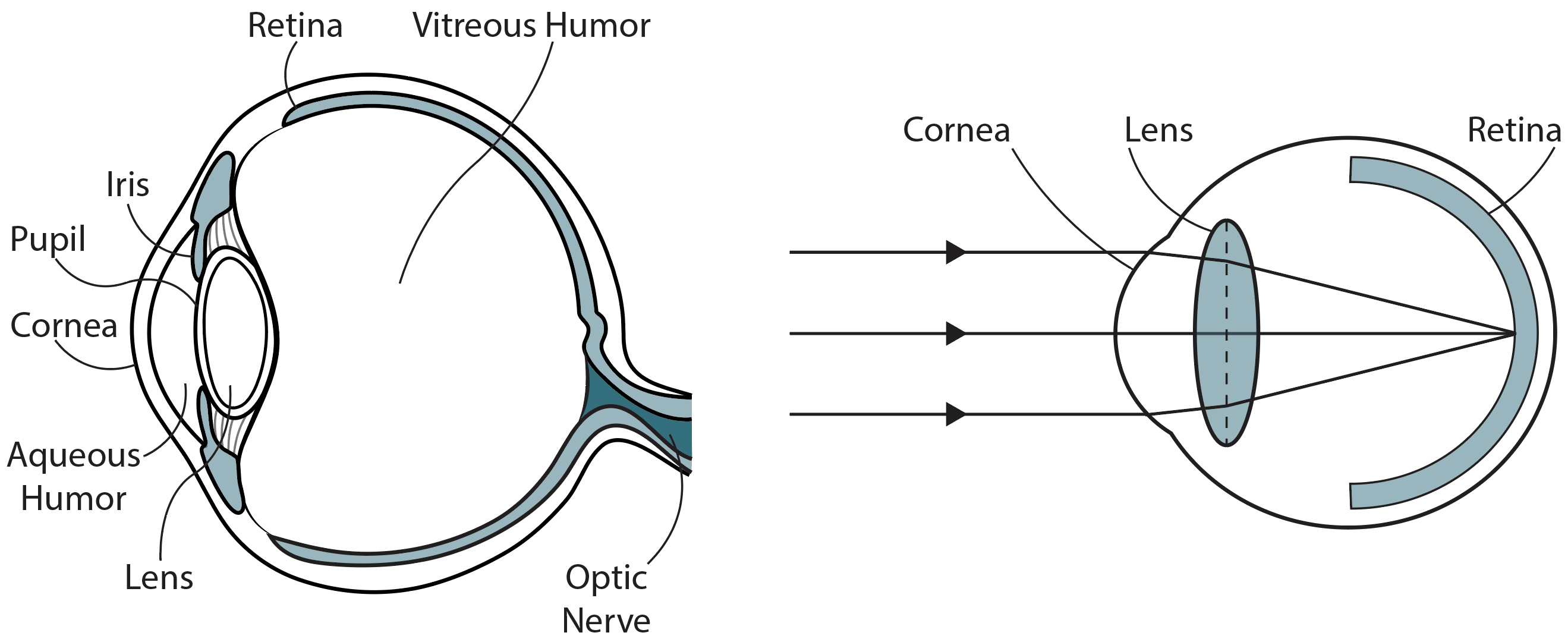
The majority of adults have some form of visual impairment. Typically, these impairments can be addressed using corrective lenses, such as eyeglasses or contact lenses. The nature and strength of these lenses depend on the nature and severity of the impairment and commonly differ from eye to eye on the same person. This case study describes the origins and correction of three common vision impairments: astigmatism, hyperopia, and myopia (with a side order of presbyopia for mature readers).
The following figure shows an anatomic cross-section of a human eye (left) and a ray diagram schematic (right) showing representative paths that light takes through the eye. Optically significant components of the eye are labeled. In brief, the cornea and lens bend and focus incident light, such that (when everything is working well) the light forms a real image on the retina.
Unfortunately, the eye is subject to optical defects, just like manufactured optical systems.
Common correctable defects arise due to irregularities in the shape of the cornea and/or lens
and from incompatibilities in the relative placements of the cornea, lens, and retina. These
defects and their corrections are described below and then explored in the context of two real-
life examples.
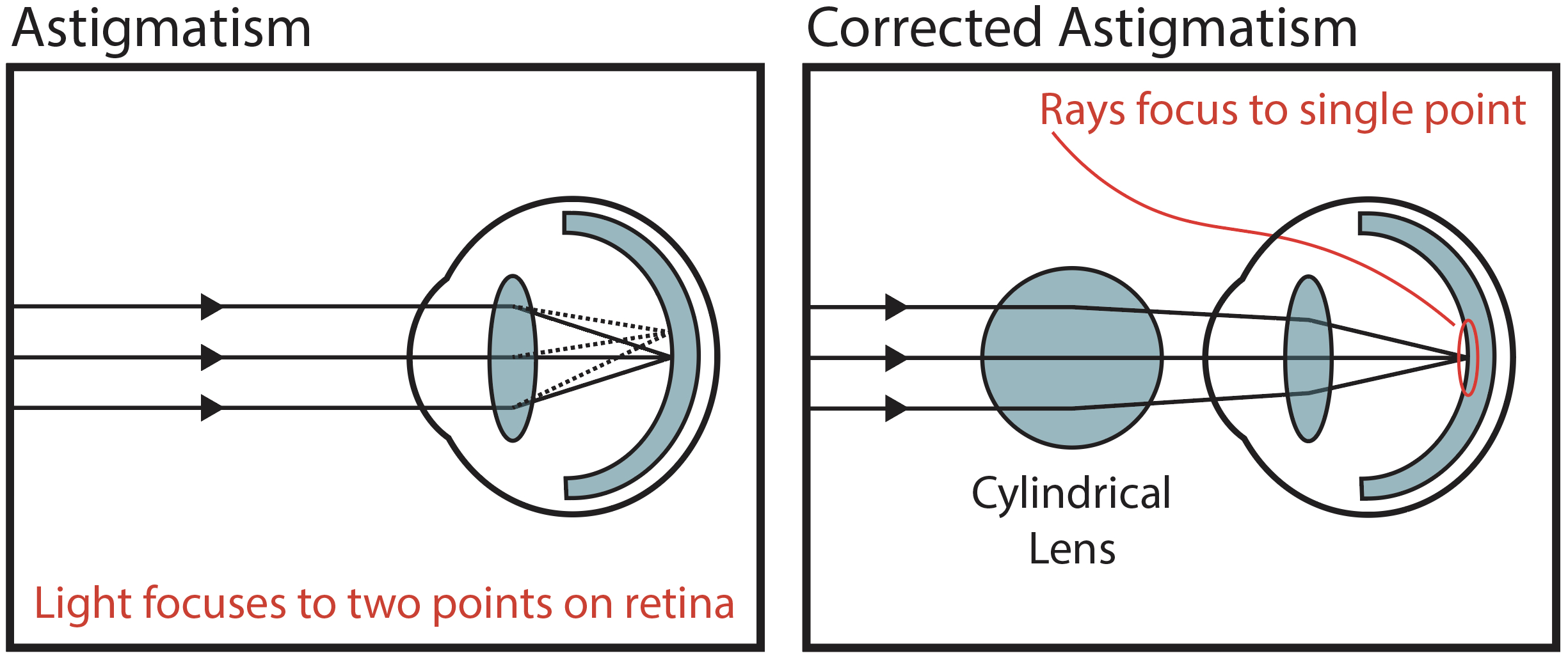
Astigmatism arises when the cornea and/or lens is not circularly symmetric. In such cases, one
or both of these elements may be stronger along one direction (e.g., horizontal) than along the
other direction (e.g., vertical). As a result, light hitting the eye along one axis may be focused in
front of, behind, or to the side of light hitting the eye along the other axis. The resulting image
will be a combination of light hitting the eye along both axes and can be blurred and/or offset,
in the latter case creating a double image.
Astigmatism can be corrected using a “cylindrical” lens that, like the astigmatic cornea or lens,
is stronger along one axis than the other. The axis of the cylindrical lens is oriented to offset the
astigmatism, leading to a single unblurred non-offset image. The resulting improvement in
vision can be dramatic.
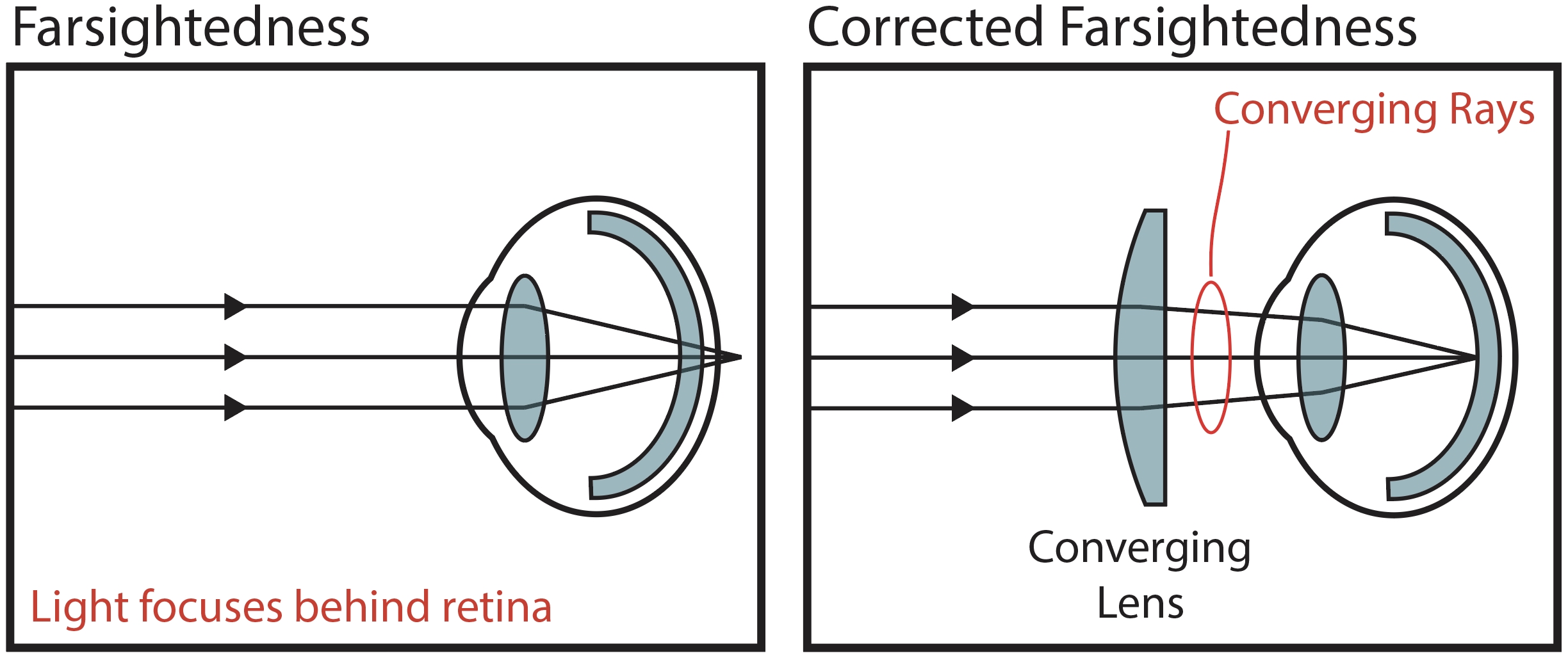
Hyperopia (farsightedness) typically arises when the eye is too short (i.e., the lens and retina
are too close together), causing the image of objects to focus behind the retina. This means
that light hitting the retina will be out-of-focus, causing blur.
Hyperopia can be corrected using a “converging” (focusing) lens. The converging lens, which is
wider in the middle, is placed between the object and the eye and assists the cornea and lens
by starting the focusing process before light hits the eye, causing the light to come to focus on
the retina, instead of behind it.
Presbyopia is another eye condition that can be corrected using a converging lens. Presbyopia is
characterized by difficulties focusing on close objects and is caused by age-related stiffening of
the lens of the eye. The “cure” is reading glasses, which use a strong converging lens to bring
nearby objects (at typical reading distance) into focus.
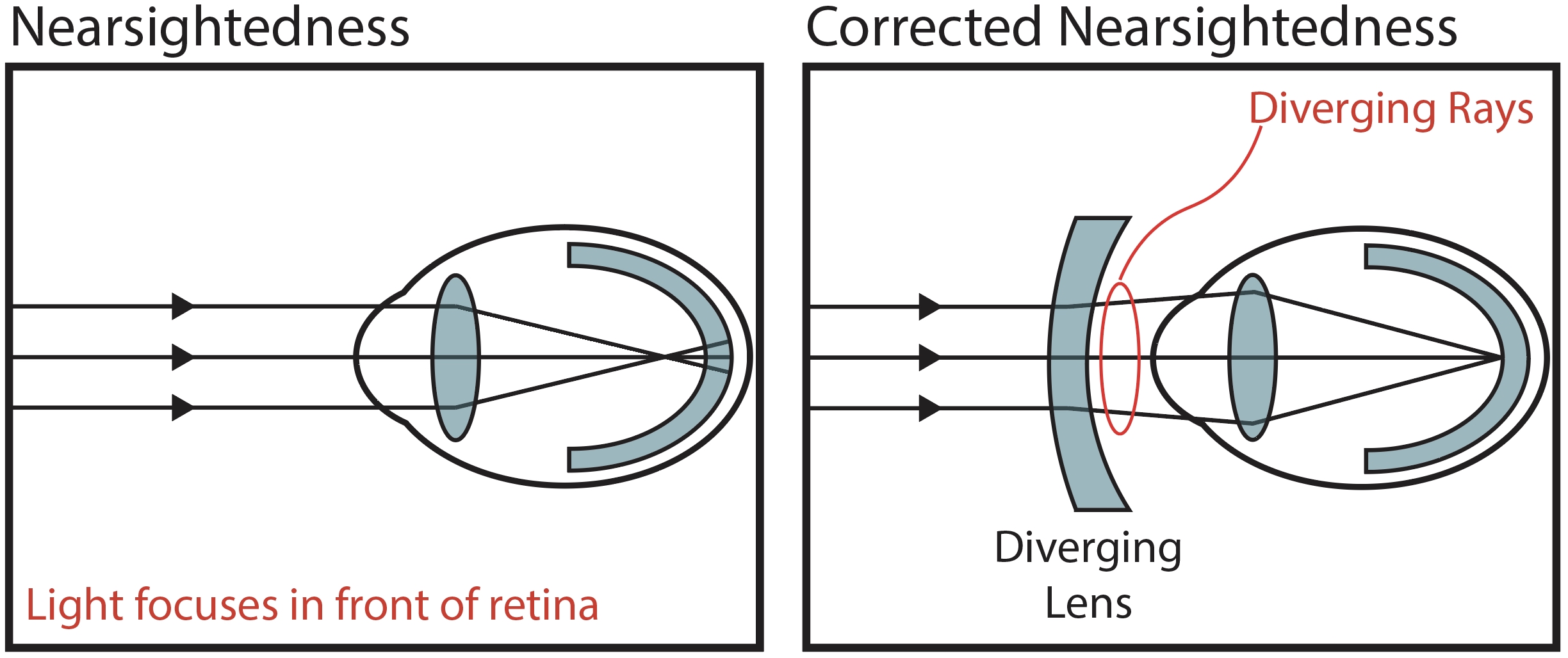
Myopia (nearsightedness) typically arises when the eye is too long (i.e., the lens and retina are
too far apart), causing the image of objects to focus in front of the retina. This means that light
hitting the retina is out-of-focus, causing blur.
Myopia can be corrected using a “diverging” (defocusing) lens. The diverging lens, which is
narrower in the middle, is placed between the object and the eye and causes incident light to
diverge before hitting the eye. The cornea and lens have a more difficult time bringing the
diverging light to focus, but because the eye is too long, the rays come to focus on the retina
instead of in front of it.
Eye examinations are used to assess both the health and optical function of the eyes. Exemplary health issues include glaucoma (i.e., damage to the optic nerve caused by excessive pressure in the eye) and retinal diseases (e.g., macular degeneration and diabetic retinopathy). Exemplary optical issues include astigmatism, hyperopia, and myopia, as described above. The most familiar product of an eye examination is an eyeglass or contact lens prescription. Eyeglass prescriptions commonly report four values, repeated for each eye:
Each lens is a blend of sphere and cylinder corrections, meaning that, unless there is no
astigmatism correction, eyeglass lenses typically lack circular symmetry.
The following prescriptions are from a happily married couple, one with hyperopia, the other
with myopia. Luckily, because they are constant companions, there is always someone to drive
the car and always someone to read the restaurant menu, even when they both have forgotten
their glasses!
Farsighted (with Astigmatism and Presbyopia) – the ever-ready car driver

This prescription corrects mild farsightedness and mild astigmatism. The small positive sphere values (+1.00 and +0.25) mean that clearer vision can be achieved by using a weak converging lens feature to begin focusing light before it hits each eye. The small cylinder values (-1.00 in each eye) mean that a weak cylinder lens feature is needed to correct an asymmetry in each eye’s cornea and/or lens. Finally, the much stronger “Add” values (+2.50 in each eye) are added for each eye to convert the standard distance prescription into a reading glasses prescription to address presbyopia that accompanies the hyperopia.
Nearsighted (with Astigmatism and Presbyopia) – the ever-ready menu reader

This prescription corrects significant nearsightedness and mild astigmatism. The significant negative sphere values (-2.50 and -2.25) mean that clear vision can be achieved by using a relatively strong diverging lens feature to defocus light before it hits each eye. The small cylinder values (-0.25 and -1.00 in each eye) mean that a weak cylinder lens feature is needed to correct an asymmetry in each eye’s cornea and/or lens. Finally, the much stronger “Add” values (+2.50 in each eye) are added for each eye to convert the standard distance prescription into a reading glasses prescription to address presbyopia that accompanies the myopia. Interestingly, adding +2.50 to the -2.50 and -2.25 sphere values create lenses with no optical power (0.00 and 0.25). In other words, these eyes work perfectly at reading distances with no glasses, hence, an ever-ready menu reader.